Understanding the individual chaff cutter parts is the fastest way to judge whether a machine is built to last or built to fail. Two chaff cutters can look almost identical on a showroom floor, yet differ enormously in blade steel, drum balance, bearing quality and motor winding. For a distributor, farm operator or feed-mill buyer, knowing what sits inside the housing turns a risky purchase into an informed one — and makes spare-part planning far easier over the machine's working life.
This guide walks through the seven main components of a typical chaff cutter, explains what each one does, and highlights the build-quality signals to check before you request a quote.
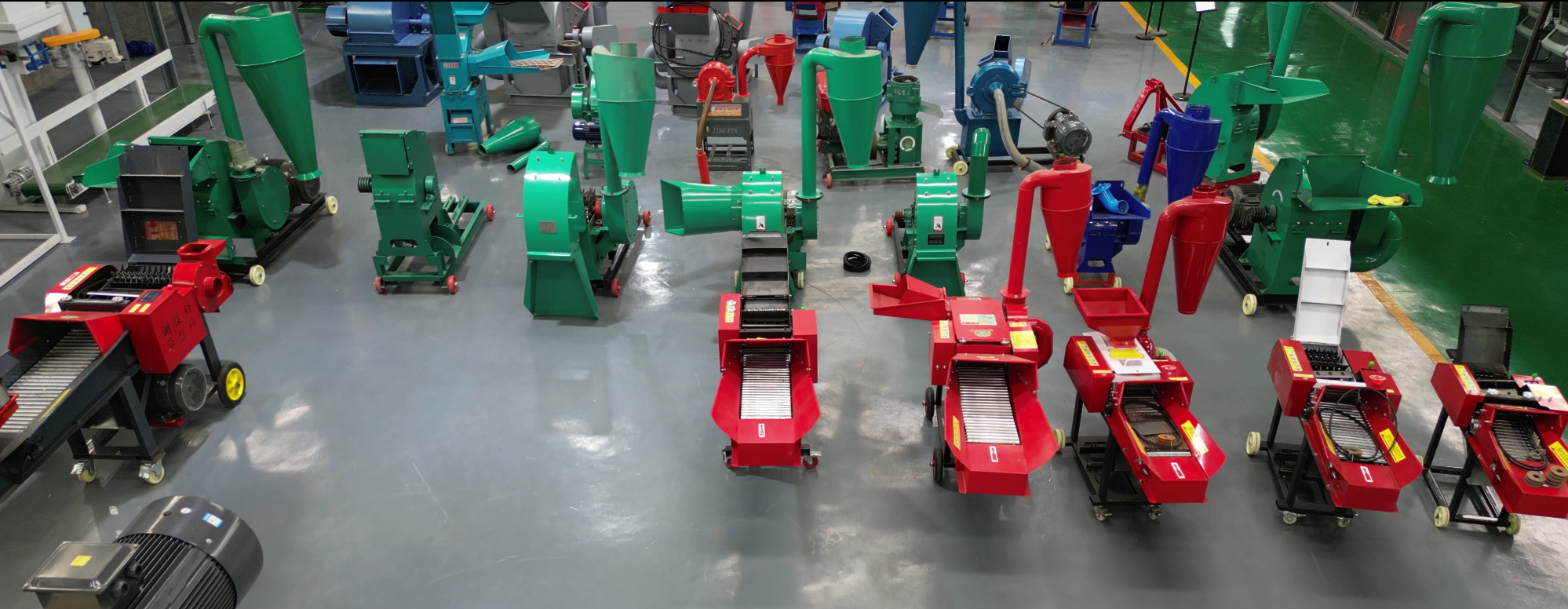
External view of a chaff cutter — the feeding chute, housing and discharge chute are the parts you evaluate first.
1. The Feeding Chute and Feed Roller
The feeding chute is where raw material enters the machine. Its design determines how easily — and how safely — an operator can feed grass, straw, hay or silage.
What to look for:
- Width and angle. A wider, gently sloped chute accepts long, tangled material such as whole straw bundles without constant pushing. Narrow or steep chutes cause bridging and force the operator to feed by hand.
- Feed roller (on powered models). Many mid- and heavy-duty machines use a toothed feed roller that grips material and pulls it toward the blades at a controlled rate. A powered feed roller keeps throughput consistent and reduces the risk of material kick-back.
- Material thickness. The chute should be made from 2–3 mm steel plate. Thin sheet metal deforms under heavy feeding and misaligns the feed path.
For wet, fibrous green fodder, a self-feeding or powered-feed design is strongly recommended — it protects both throughput and operator safety.
2. The Cutting Drum (or Cutting Disc)
The cutting drum is the heart of the machine. It is a rotating assembly that carries the blades and delivers the kinetic energy needed to shear fibrous material.
Key build-quality signals:
- Dynamic balancing. A well-manufactured drum is dynamically balanced. An unbalanced drum causes vibration, accelerates bearing wear and shortens motor life.
- Shaft and bearings. The drum shaft should run on sealed, greasable bearings mounted in a rigid bearing housing. Cheap bushings instead of real bearings are a common cost-cutting shortcut.
- Drum speed. Typical electric chaff cutters run the drum at roughly 1,500–2,800 rpm depending on design. Higher speed gives a cleaner cut but demands better balancing and stronger bearings.
3. The Blades — The Part That Actually Cuts
Blades are the most critical — and most frequently replaced — of all chaff cutter parts.
Blade types:
| Blade type | Typical use | Notes |
|---|---|---|
| Straight flat blades | Dry straw, hay, light grass | Simple, easy to sharpen, lowest cost |
| Curved / sickle blades | Green fodder, silage, tough stems | Better slicing action, less wrapping |
| Multi-blade sets (3–6) | Heavy-duty and high-capacity machines | Smoother cut, higher throughput |
Material and hardness. Quality blades are made from high-carbon or alloy tool steel and heat-treated to a hardness typically in the 48–58 HRC range. Blades that are too soft dull quickly; blades that are too hard chip when they hit grit, stones or fence wire hidden in the fodder.
Cutting length. Cutting length is set by the combination of blade count, drum speed and feed rate. Most machines offer adjustable cutting lengths — commonly in the range of roughly 10–50 mm — by changing feed roller speed or blade configuration. Confirm the achievable range with the manufacturer for your specific model.
Sharpening and replacement. Ask how many sharpenings a blade set tolerates before replacement, and whether replacement blades are available as a standard spare part. A machine with proprietary, hard-to-source blades becomes expensive to own.
4. The Motor or Power System
The power source defines where and how the machine can be used.
Electric motor:
- Clean, quiet, low running cost, ideal where three-phase or single-phase power is reliable.
- Look at rated power (kW), duty cycle and insulation class. For continuous farm work, a motor rated for heavy duty with adequate cooling is essential.
- As a reference point, FCN.FM's vertical and horizontal chaff cutter models in the 2.8 series use a 4KW motor with a capacity of 600-800kg/h, while the larger 3.8 vertical model uses a 5.5KW motor rated at 800-1500kg/h.
Diesel engine:
- Preferred in regions with unreliable grid power or for field-side and mobile operation.
- Adds weight, noise and exhaust, but gives full independence from electricity.
PTO / tractor-driven:
- Uses the tractor's power take-off, eliminating a separate engine or motor. Best suited to larger farms that already operate tractors.
Match the power system to your actual site conditions before choosing a model — oversizing wastes money, undersizing shortens motor life.
5. The Discharge Chute and Blower
Once material is cut, it must leave the machine cleanly. The discharge chute directs chopped fodder into a bag, cart, trailer or silage pit.
Design points:
- Throw distance and height. A well-designed drum and discharge geometry throws material far enough to fill a trailer or bunker without clogging.
- Adjustability. A rotating or pivoting discharge chute lets the operator direct material where it is needed.
- Clog resistance. Smooth internal surfaces and adequate clearance reduce wet-material build-up, which is the most common cause of blockages when processing silage.
6. Frame, Housing and Safety Features
The frame and housing hold every other component in alignment. Rigidity here protects blade geometry, bearing life and operator safety.
What to check:
- Frame construction. A welded steel-tube or heavy plate frame resists the vibration of a spinning drum far better than bolted light-gauge sheet.
- Housing. The cutting chamber should be fully enclosed in thick steel to contain flying debris.
- Safety devices. Look for a feed-guard or emergency stop, a guarded discharge area, and secure blade access covers. Machines intended for commercial use should meet the safety expectations of your local market.
- Mobility. Wheels or a tow hitch are valuable for moving the machine between feed stores and paddocks.
7. Fasteners, Bearings and Wear Parts
Beyond the headline components, a set of smaller parts determines long-term cost of ownership:
- Bearings and seals — protect the drum shaft from dust and moisture.
- V-belts and pulleys — transfer power from motor to drum; quality belts slip less and last longer.
- Blade bolts and lock nuts — must withstand high vibration without loosening.
- Feed roller teeth — wear parts on powered-feed machines.
Before buying, ask the supplier for a spare-parts list and confirm which of these items are held in stock. A machine is only as reliable as the availability of its wear parts.
Seeing the Machine in Action
Specifications on paper only tell part of the story. Watching a machine cut wet green fodder and dry straw side by side reveals vibration, discharge throw, blockage behaviour and cut quality that a spec sheet cannot.
Chaff cutter working — observe cut uniformity, discharge throw and stability under load.
How to Use This Knowledge When Buying
Use the component checklist above as a structured way to compare quotes:
- Ask about blade material and hardness, and how many sharpenings a set tolerates.
- Confirm bearing type — sealed greasable bearings, not plain bushings.
- Verify motor rating and duty cycle against your intended daily hours.
- Request the spare-parts list and lead times for blades, belts and bearings.
- Check frame and housing thickness — this is where low-cost machines cut corners first.
- Ask about cutting-length adjustment and whether it suits your livestock's feeding requirements.
A supplier who can answer these questions clearly — with real specifications and real spare-parts support — is a supplier worth shortlisting.
Conclusion
A chaff cutter is a simple machine in principle, but the difference between a machine that runs for years and one that fails in its first season lies entirely in the quality of its parts: the steel in the blades, the balance of the drum, the bearings on the shaft and the rating of the motor. By evaluating each component — and confirming spare-part availability up front — you protect both your investment and your feeding operation.
FCN.FM (Henan Macin Machinery Equipment Co., Ltd.) manufactures chaff cutters and animal feed processing equipment in its own facility and supports OEM/ODM customization, spare-parts supply and technical guidance for international buyers. If you would like help selecting a model, confirming specifications or arranging a spare-parts package, contact the FCN.FM team for a tailored recommendation.
References
- FCN.FM — Chaff Cutter Machine product pages: https://www.chaffcuttermachine.com/
- Henan Macin Machinery Equipment Co., Ltd. — company and manufacturing overview: https://www.chaffcuttermachine.com/about-us/
- FAO — Animal feed and fodder processing guidance: https://www.fao.org/